
5 Brake Warning Signs in the UAE Every Motorist Must Know
Your brakes rarely fail without giving you a chance to catch the problem first. The trouble is that the warning usually arrives quietly, as a sound, a feeling through the pedal, or a slight pull to one side, and it is easy to explain away rather than act on. Recognizing 5 brake warning signs in the UAE roads tend to bring out earlier than most other places starts with knowing exactly what each clue means, since the causes here often differ from what a driver in a cooler climate would experience.
Why UAE Roads Push Brakes Harder Than Most Places
The UAE’s road network combines some of the fastest, most consistent high-speed highways in the world with dense stop-and-go traffic in areas like Deira, Bur Dubai, and Sharjah’s commercial districts. Sustained high-speed driving generates significant heat in the braking system, while frequent city traffic means the brakes engage far more often per kilometer than they would on a typical rural highway elsewhere. Add in extreme ambient heat, which limits how quickly the brake system can shed the extra heat generated during braking, and it becomes clear why components here often wear faster than intervals written for cooler climates.
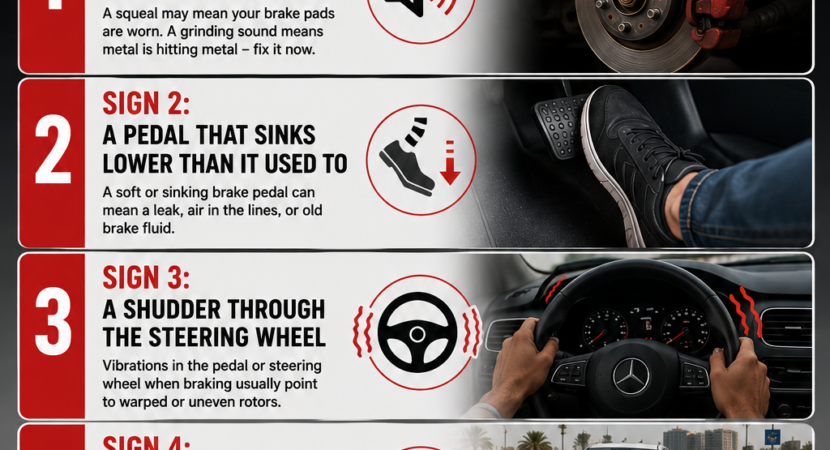
Sign 1: A Squeal or Grind That Won’t Go Away
A high-pitched squeal during braking is usually intentional, since many brake pads include a small metal wear indicator that makes contact with the rotor once the pad material wears down to a certain thickness, deliberately creating noise to alert the driver. A grinding sound is a different matter entirely, and it usually means the pad material has worn away completely with metal now grinding directly against the rotor, causing rapid damage that should be addressed immediately rather than left for a routine appointment.
Sign 2: A Pedal That Sinks Lower Than It Used To
A brake pedal that feels softer than usual or sinks further toward the floor before the car actually slows typically points to air in the brake lines, a fluid leak, or brake fluid that has absorbed moisture over time. Brake fluid naturally draws moisture from the air over months and years, which lowers its boiling point and can produce a spongy pedal feel during hard or repeated braking when the fluid heats up, and this is one of the reasons brake fluid needs periodic replacement even when the pads themselves still look fine.
Sign 3: A Shudder Through the Steering Wheel
A noticeable vibration through the brake pedal or steering wheel when braking, especially at higher speeds, usually points to warped or unevenly worn rotors. Repeated heat cycling, where a rotor heats up sharply during hard braking and then cools rapidly, can gradually warp the metal out of its perfectly flat shape, and once that happens, the pad makes uneven contact with the rotor’s surface on every rotation, which is exactly what produces that pulsing sensation.
Sign 4: A Car That Pulls to One Side When You Brake
If your vehicle pulls noticeably to one side specifically when braking, rather than while driving straight, the cause is often uneven pad wear between the front wheels, a caliper that is not releasing properly on one side, or in some cases an alignment issue amplified during braking. This should not be ignored, since uneven braking force between wheels affects vehicle stability, particularly during an emergency stop at highway speed, and a wheel alignment and steering assessment is often the fastest way to rule that variable in or out.
Sign 5: A Dashboard Light You’re Tempted to Dismiss
Modern vehicles include a brake warning light that can indicate several different issues, from low fluid level to worn pads on cars with electronic wear sensors to a fault in the anti lock braking system. It is tempting to assume the light is a glitch if the brakes still feel normal, but this warning exists precisely because certain brake issues do not always show up through pedal feel alone until they have already progressed, so having it read properly through an onboard fault code scan is worth doing rather than guessing.
How Tires and Alignment Quietly Affect Braking
Brake performance does not exist in isolation from the rest of the car’s chassis. Uneven wear from your tires can affect how braking force is distributed across all four wheels, and poor wheel alignment can cause a car to pull under braking even when the brake components themselves are in good shape, while a worn or leaking component in the suspension and shock absorber setup can also transmit vibration in a way that feels identical to a warped rotor, which is why a thorough inspection looks at more than the brakes alone.
What a Proper Brake Inspection Actually Covers
A thorough inspection goes beyond a quick glance at pad thickness, typically including measurement of remaining pad material against the manufacturer’s minimum safe thickness, a check of rotor surfaces for scoring or warping, testing of brake fluid condition and moisture content, confirmation that each caliper releases properly, and an assessment of brake lines for wear or leakage. The nonprofit Car Care Council, a well-known authority on vehicle maintenance in the United States, recommends having the entire brake system checked at least once a year regardless of whether any symptoms are present, since some forms of wear are not noticeable until they are well advanced, and their full brake safety guidance is available on the Car Care Council website.
Driving Habits That Quietly Add Years to Your Brakes
A few driving habits make a real difference in how long brake components last. Leaving a larger following distance reduces how often you need to brake hard, which lowers the heat generated per stop, while anticipating a slowdown earlier, rather than braking suddenly at the last moment, spreads the braking force over a longer distance and reduces peak heat buildup at any single point. It also helps to avoid resting a foot lightly on the pedal while driving, since even light, continuous pressure generates unnecessary heat and wears the pads down faster than normal use would, and heavy loads make a noticeable difference too, since a car carrying passengers, luggage, or towing equipment needs significantly more stopping distance and puts more strain on the same components, which is worth remembering before a long highway trip between emirates.
Why Waiting a Little Longer Rarely Pays Off
Delaying brake attention rarely saves money in the long run. Worn pads left unaddressed eventually damage the rotor surface underneath, turning what would have been a straightforward pad replacement into a pad and rotor job, and a sticking caliper left unresolved can wear a pad unevenly and much faster than normal, sometimes cutting its lifespan by half. A spongy pedal caused by degraded fluid, if ignored long enough, can progress to the point where actual stopping distance is compromised, which is a risk not worth taking to save on a routine brake fluid and component check.
Getting an Expert Opinion Before It Escalates
ZinQ Garage certified brake technicians follow the full inspection process described above rather than simply replacing pads and calling the job done, since a pad swap alone will not resolve a warped rotor, a sticking caliper, or degraded fluid underneath. Where a dashboard warning light points to something less obvious, a full vehicle diagnostic check confirms exactly what triggered it before any parts are touched, and brakes generally give more warning than most people realize, with the signs almost always present before anything serious happens.
Don’t Wait for All Five Signs to Show Up
Treating even one of these warning signs as a reason to book a check, rather than waiting for all of them to appear together, is what keeps a small fix small. Book a full brake inspection with ZinQ Garage and get a clear answer before a routine repair turns into a safety risk.